
We have been in the real estate business in East Africa for a long time.
Long enough to see markets come and go. Long enough to recognise when a market is genuinely positioning itself for growth. And long enough to know the difference between hype and a real opportunity.
Uganda in 2026 is a real opportunity. But it is a more complicated one than most of what gets written about it, and the people who lose money here are usually the ones who read the optimistic half and skipped the rest.
So this is both halves. What is driving the market, what the returns actually look like, how ownership and financing work, and where the market is already showing strain.
How big is the real estate business in Uganda?
Uganda’s population reached 45.9 million at the 2024 national census, growing at 2.9% a year. Half of that population is under 18. Whatever else is true about this market, the demand side is not a forecast. It is a demographic fact with a twenty-year runway.
The macro picture backing it is unusually stable by regional standards.
| Indicator | Latest position | Why it matters to property |
| GDP growth | 6.3% in FY2025/26 (Q1-Q3). Bank of Uganda projects 6.5-7.0%, rising to around 8% medium term. | Sustained growth builds the middle-income buyer pool that mid-market housing depends on. |
| Inflation | Around 3%, below the Bank of Uganda’s 5% medium-term target. | Low inflation protects construction budgets and off-plan pricing. |
| Central Bank Rate | 9.75%, held for seven consecutive meetings to May 2026. | Stable policy rate, but commercial lending rates remain high. Mortgages are expensive. |
| Oil | First exports expected late 2026 via Tilenga, Kingfisher and EACOP. | New employment corridors, new expatriate housing demand, and a fiscal boost from 2027. |
| Kampala rents | Up roughly 6% year-on-year to early 2026. | Ahead of inflation. Real rental income is growing. |
| Prime occupancy | Around 80%, down from 84% in 2024. | The prime segment is softening. This is the number most articles leave out. |
What is driving the real estate business in Uganda
A widening middle class
Consistent 6%-plus growth over more than a decade does something specific to a country. It creates a class of professionals, business owners and entrepreneurs who have money and opinions about how they want to live. That is a different buyer from the one Kampala developers were building for fifteen years ago, and the product has not fully caught up.
Urbanisation, but not where people assume
Here is a correction worth making, because a lot of Ugandan property writing gets it wrong. Kampala Capital City is not the fastest-growing part of Uganda. Between the 2014 and 2024 censuses, the growth went outward. Wakiso and Mukono absorbed it.
The Greater Kampala Metropolitan Area is the real unit of analysis. Kira, Najjera, Kyanja, Ntinda and Bukoto are where household formation is happening and where apartment appreciation has been strongest.
The city centre still anchors offices, embassies and jobs. But if you are buying for yield rather than prestige, the ring is where the arithmetic works. Infrastructure delivery under Uganda’s Vision 2040 is what determines which parts of that ring get there first.
Diaspora capital
Ugandans abroad sent home $2.5 billion in 2025, outperforming coffee exports at $2.46 billion. A growing share of that is investment rather than consumption, and diaspora buyers have become considerably more demanding about build quality, title clarity and management standards. We have written separately about what diaspora buyers are actually looking for, because it is a distinct buying behaviour and it deserves more than a paragraph.
Foreign direct investment and the oil corridor
When a multinational posts senior staff to Kampala, those people need somewhere to live that meets an international standard. More companies means more executives means more demand for managed, secure, well-finished residential stock. Oil sector build-out through 2026 and 2027 adds a second, geographically distinct source of that demand. Our piece on what foreign buyers prioritise in Uganda goes into the specifics.
The main segments of Uganda’s real estate business
“Real estate business in Uganda” is not one business. It is at least seven, with very different capital requirements and risk profiles.
| Segment | Entry capital | Profile |
| Mid-market residential | Moderate | The deepest tenant pool in Greater Kampala. Vacancy around 8% in well-priced Ntinda and Bukoto stock. Least glamorous, most reliable. |
| Prime and luxury residential | High | Kololo, Nakasero, Naguru, Munyonyo, Muyenga. Highest ticket, but also the segment currently carrying vacancy near 18% and softening rents. |
| Commercial office | High | Concentrated in the CBD and Nakasero. Tenant demand is institutional and slow-moving. |
| Retail | High | Anchored by malls and neighbourhood centres. Highly location-dependent. |
| Industrial and warehousing | High | Underbuilt relative to demand, particularly along the Kampala-Jinja corridor. Quietly one of the more interesting plays. |
| Land banking | Low to moderate | Cheapest entry, longest hold, highest title risk. No income while you wait. |
| Short-term rentals | Moderate | Growing in Kampala and Entebbe but still niche. Occupancy runs roughly 40-45% in the strongest neighbourhoods. |
If you are weighing the two most common entry points against each other, we have a fuller comparison on whether to buy land or buy an apartment in Uganda.
What returns actually look like in Kampala
Most articles about the real estate business in Uganda promise high returns and then decline to say what they are. Here are the working numbers as of early 2026.
| Metric | Prime areas | Secondary suburbs |
| Gross rental yield | Around 6-8% | Around 8-11% |
| Occupancy | Around 80%, down from 84% | Around 92% in well-priced stock |
| Vacancy rate | Up to 18% in expat corridors | Around 8% |
| Days on market (resale) | 75-110 days | Around 75-110 days; houses 120-180 |
| Rent direction | Prime 2-bed rents dipped while sale prices rose | Up roughly 6% year-on-year |
Read those two columns against each other and the honest conclusion is uncomfortable for a company that builds premium residential: the yield is currently better in the suburbs than at the top of the market. Prime sale prices have kept climbing while prime rents dipped, and that gap is the classic signal of a segment that has run ahead of its tenant base.
That does not make prime a bad investment. It makes prime a selective one. In a softening segment the difference between a well-located, well-managed, properly finished building and an average one stops being a matter of taste and starts being the entire return.
Why real estate rather than another asset class
It is a tangible asset with a real use
A property has a floor under its value that a share certificate does not, because someone can always live in it. That is a genuine advantage. It is not the same as saying property cannot lose value, and anyone who tells you that is selling something. Ugandan property is less volatile than equities but far less liquid, and in a downturn the cost shows up as time on market rather than a price on a screen.
It holds value against the shilling
Inflation is currently low, but Uganda’s history says that is a condition, not a guarantee. Rents and replacement costs adjust with the currency in a way that fixed-income holdings do not.
Supply is genuinely constrained where it counts
Serviced, well-located land in Greater Kampala is finite. Construction costs are high and largely import-linked. Formal, financeable, properly titled stock is a small fraction of total housing. That constraint is real and it is the strongest structural argument for the asset class here.
You do not have to manage it yourself
Uganda’s professional property management sector has matured enough that passive ownership is viable. For a diaspora or foreign investor it is the only sensible structure. Budget for it as a real line item, not an afterthought.
Ownership and land tenure: what you have to get right
This is where deals in Uganda go wrong, and it is the section most articles skip. Uganda recognises four land tenure systems and they are not interchangeable.
- Mailo. Unique to Buganda, including Kampala. Land ownership and occupancy rights can sit with different people, which means a valid title does not always mean vacant possession. Verify occupancy, not just ownership.
- Freehold. Full ownership in perpetuity. The cleanest form, and restricted to Ugandan citizens.
- Leasehold. Granted for a fixed term, commonly up to 99 years. This is the route available to non-citizens.
- Customary. Held under community norms, often undocumented. Common outside urban areas and the hardest to finance against or resell.
Foreign buyers
Non-citizens cannot hold mailo or freehold land in Uganda. They can hold leasehold interests of up to 99 years, and they can own condominium units under the Condominium Property Act, which is why apartments are the practical entry point for most foreign and diaspora buyers. Foreign investors seeking an investment licence generally need to demonstrate a minimum investment of USD 250,000.
Title verification is not optional
Every purchase should include a search at the Ministry of Lands registry and on the UgNLIS portal, confirmation that the certificate of title is genuine and unencumbered, a physical inspection for occupants or competing claims, and an independent surveyor confirming that the boundaries on the ground match the boundaries on paper. Instruct your own lawyer. Not the seller’s, not the agent’s.
How the business gets financed
Financing is the constraint that shapes almost every decision in Uganda’s property market.
- Mortgages exist, and banks typically lend up to around 70% loan-to-value on residential projects. But with the Central Bank Rate at 9.75%, commercial lending rates sit well above it. Debt is available and it is expensive.
- Off-plan payment plans from developers are, in practice, the most widely used financing mechanism in the market. They spread payment across the construction period at no interest. They also transfer delivery risk to the buyer.
- Equity partnerships and joint ventures with landowners reduce the upfront capital requirement, and remain the standard structure for first-time developers.
- Uganda’s first REIT launched in 2023, opening a route for smaller investors to gain exposure without buying a whole unit.
- Development finance institutions, including the African Development Bank, provide concessional funding for affordable housing projects.
The risks nobody puts in the brochure
We would rather you hear this from us than learn it after the transfer.
Title fraud and double sales
The single most common way people lose money in Ugandan real estate. Forged titles, land sold twice, and mailo plots sold without regard to sitting occupants. The defence is procedural, not intuitive: registry search, independent lawyer, independent surveyor, no cash payments outside the escrow structure. We have written a full walkthrough on how to avoid a bad real estate deal in Uganda.
A softening prime segment
Prime occupancy at around 80% with vacancy near 18% in expat corridors means new supply has outpaced demand at the top of the market. If you are buying prime for rental income, underwrite conservatively and assume longer void periods than the sales brochure suggests.
Off-plan delivery risk
Off-plan is how most of this market is financed, which means most buyers are taking developer risk. Uganda has no standardised escrow requirement for off-plan payments, so contract terms carry the protection. Check completed projects, not renders. We have said more about this in you can’t trust the brochure.
Liquidity
You cannot exit a Ugandan property in a week. In a stressed sale, historical patterns suggest discounts in the range of 10-20% for sellers who need to move quickly. Buy with a holding period you can actually commit to.
Currency and cost exposure
Construction inputs are largely imported. A weakening shilling raises build costs and squeezes developer margins mid-project, which is one of the more common causes of delayed handover.
Service charges and management quality
A cheap unit in a badly run building is not a cheap unit. Ask for the service charge history and the maintenance record before you ask about the price.
Who this market actually works for
Uganda’s real estate business rewards a specific profile. Investors with a five-year-plus horizon, the patience to do proper title work, the discipline to buy on yield arithmetic rather than on a rendering, and enough capital to hold through a soft patch without being forced to sell.
It punishes the opposite: short horizons, unverified titles, and buying the top of the market on the assumption that prime always outperforms. Right now in Kampala, it does not.
If you want the full pre-purchase checklist, our guide to things to consider when investing in Ugandan real estate covers the ground in more detail.
Where VAAL fits
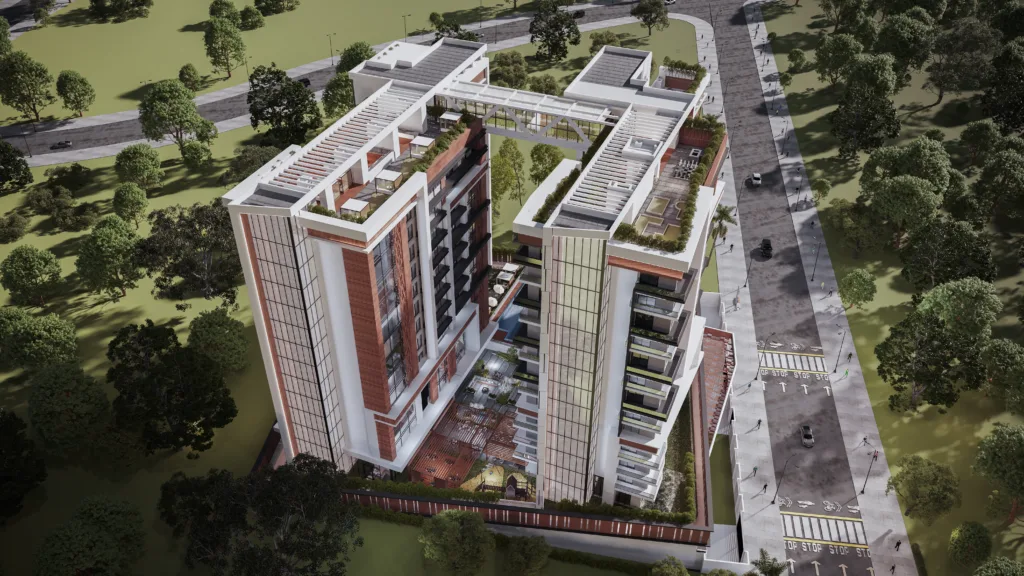
We build in this market with our own capital, which means we carry the same risks we have just described. The Bridge, Kololo and Cadenza Residence are the answer to a specific question: what does prime residential look like when it is built to hold its value in a segment that is getting more competitive, not less.
If you are weighing Uganda seriously, the useful next step is a conversation about your specific horizon, budget and yield expectations rather than a brochure. Speak to one of our property consultants or call +256 765 500 000.
FAQ
1. Why is Uganda’s real estate market attracting investors?
Uganda’s real estate market is supported by economic growth, rapid urbanization, rising incomes, foreign direct investment, and increasing demand from local professionals, expatriates, and diaspora buyers.
2. What is driving the growth of luxury real estate in Uganda?
The luxury segment is growing because affluent Ugandans, international executives, business owners, and diaspora investors increasingly expect high-quality apartments with modern finishes, security, amenities, and professional management.
3. Why is Kampala the center of Uganda’s real estate opportunity?
Kampala remains Uganda’s main commercial, financial, diplomatic, and employment center. Its growing population and concentration of businesses and international organizations create sustained demand for premium residential property.
