
Rarely do people move to Uganda long-term on a whim.
We know it’s something we’d want to believe, but it’s rare that someone picked up an architectural magazine, read a real estate feature and saw nice renderings, fell in love with what they saw and instinctively dipped into their savings account, flew halfway across the globe, landed in the Pearl of Africa, and bought an apartment in Nakasero. That’s almost never it, but rather, real estate investment from the diaspora shows up for very specific, calculated reasons.
It usually has something to do with a development contract, or setting up infrastructure within the oil sector, or a foreign mandate within a multinational NGO, or the planned expansion of an organization within the region. Those are the kinds of business assignments that usually are accompanied by a luxurious housing allowance, usually poised long-term and meant to facilitate a standard of living for the occupant that feels very identical to something they are accustomed to from the country that they are coming from.
Now that’s the kind of foreign investor that the Ugandan luxury market is actually competing for. Sometimes our minds instinctively deviate to the casual tourist skimming through the country, or the national in the diaspora that feels a need to invest back home emotionally, but in reality, it’s the well-traveled and exposed professional that’s lived in Nairobi, Amsterdam, and Ottawa, and is now relocating temporarily to Uganda, who is going to compare their living experience in Kampala to whatever they have experienced in all the countries that they have been in and compare their apartment, not to the last one they stayed in, down to the smallest details, and use that to benchmark whether they want to make it a worthy purchase.
Now, understanding this specific type of person, from who they are, why they are here, what they enjoy, and what their non-negotiables are, is the only way to understand why the luxury segment in Uganda’s real estate market works the way it does and is growing in the trajectory we see it taking and how it rewards the developers and investors that seem to understand it and take it seriously.
Let’s start with the profile of these investors.
Foreigners in Uganda

The statistics show that Uganda hosts an estimated one to two million foreign nationals. However, let’s give some context to what this really means.
The majority of this population comes from the surrounding areas in the region, majorly consisting of migrants from DRC, Rwanda, South Sudan, and other areas that have come into Uganda for either trade, seeking to get jobs, or providing some sort of labor and, in many cases, refuge. Taking a deeper look into this profile makes it apparent that these are neither the buyers nor the tenants that we would categorize as part of the prime luxury market.
The group we ought to set our eyes on happens to be much smaller: those that care and create the demand for luxury residential properties. This far more potent group is more economically potent and is comprised of a community of several thousand expatriates, supplemented by an increasing number of Asian professionals, and all these find themselves clustered in one large zone, the diplomatic and commercial areas of Kampala, right by the CBD.
Additionally, Kampala, as of today, hosts around 54 foreign embassies, consulates, and diplomatic representations, making it one of the most diplomatically active capitals in Africa. Note the magnitude in the growing city of Kampala. And behind each of these organizations is a growing number of institutional staff, usually accompanied by their families, and an even larger circle of affiliates like the contractors, consultants, and legal advisers, who too are present in the vicinity.
Adding onto that, Uganda’s pivotal role politically as a major host of displacement and a regional hub for conflict resolution has caused the United Nations and its affiliate organizations to set up robust operations in the nation, creating need for a grounded hub within Kampala. Now add onto that the executive staff of the multiple multinational NGOs that have set up shop in Uganda over their multiple years of operations. Then you can start to fathom the structural depth of the demand in Kampala.
Real estate investment

And then the emerging commercial layer. The Uganda economic growth forecast, which sits at 8.5% for 2025 and is projected to reach 10% in 2026, according to The Africanvestor’s market analysis, is a clear indication of the increasing potential of the economy, and all this is happening at the very time the oil sector is beginning to move into production.
Commitments by projects like the East African Crude Oil Pipeline (EACOP) and the Tilenga and Kingfisher oil projects are just an insight into the kind of long-term infrastructure investment that leads to an influx of experienced engineers, project managers, and senior-level executives from all around Africa and the world into the Ugandan market. Foreign direct investment into Uganda reached $3.3 billion in 2024, most of it tied directly to the oil and energy sector, and senior energy executives, in every market they’ve operated in, are among the most demanding tenants in any luxury residential segment.
And looking into the nationalities that are represented most in the prime residential neighborhoods, being European (particularly British, German, and Scandinavian), Americans, and well-educated and experienced Asians from the Chinese and Indian economies, it is evident that these are people whose housing expectations were set in markets where luxury is clearly defined and speaks for itself. With such groups, luxury isn’t a privilege; it’s an expectation.
Backup power is built into their understanding of living, professional management is a fundamental requirement for a living space, and the nature of the building you live in is meant to, in a way, reflect something about who you are and what level of the international professional ladder you’ve reached.
Now, understanding this community helps you understand where to put your money because it is a clear indication of where the demand is.
What do you look for when investing in Uganda
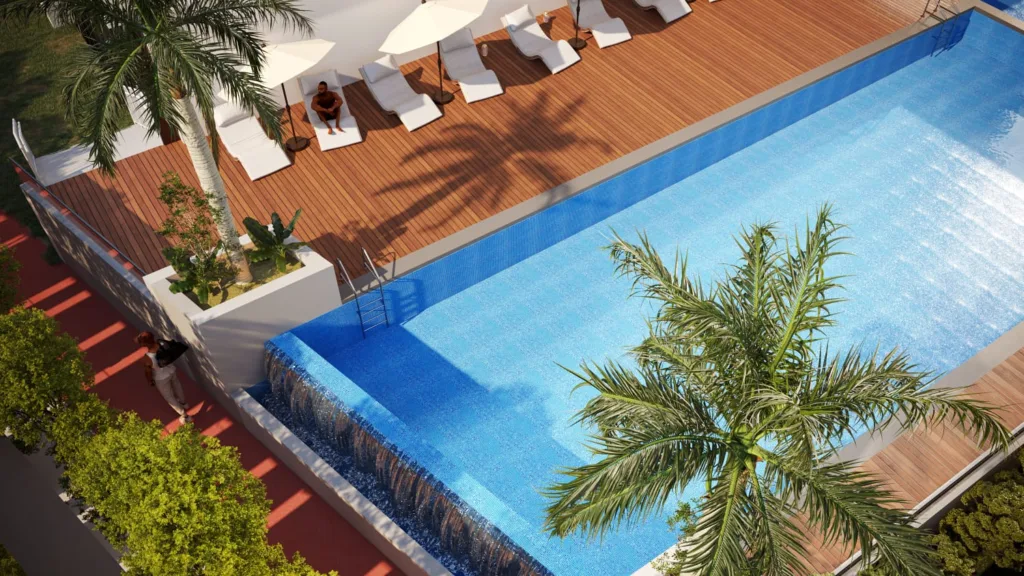
Understanding this demand helps you look into the market in which it is reflected.
In the global real estate environment, 5–7% yields are considered relatively strong, and many mature markets, including Nairobi, East Africa’s most mature market, have historically been proud of delivering returns in that range. When Kampala’s numbers are computed alongside the rest in its vicinity, it starts to look like a misprint, because for some developments we are seeing 3–5 times the numbers Nairobi boasts of.
And to back it up, Kampala’s prime residential occupancy was running at approximately 80% in the Knight Frank H1 2025 Market Review, which is a figure that denotes a clear structural undersupply and speaks to the heavy demand that we noted earlier on. Even more, the UBOS Census 2024 confirms the clear urbanization trajectory that every long-term real estate investor wants to see: more people arriving in the city to take advantage of new professional opportunities, which in turn generates the sustained demand for quality housing that currently exceeds the market’s ability to supply it.
And to add onto that, Uganda’s inflation dropped from over 7% in 2022 to 3.1% in late 2025, which signals that the real returns you’d expect to earn aren’t being eroded month to month and that USD-denominated rental income carries genuine purchasing power.
What VAAL offers.
The clear trend shows something remarkable. A studio apartment at Cadenza Residence, which was acquired at pre-launch pricing of $72,000 and rented at $2,730 per month against the prevailing market rates, generates a projected gross annual yield of 45.5%. The numbers hold!
This is a clear sign that Uganda, seen from the eyes of a foreign investor looking at where to put their money, presents itself as an opportunity with maximum returns.
So, with the promise of luxury clear and the investment fundamentals in the right direction, VAAL Real Estate is creating the perfect place for the convergence of these opportunities, with our projects like Cadenza Residences, shown earlier, and The Bridge in Kololo.
If you’re interested in exploring the opportunities Uganda can unveil, contact us at vaal.co.ug and schedule a private consultation with our team.
FAQ
1. Is Uganda a good place to invest in real estate?
Yes, Uganda is increasingly becoming an attractive destination for real estate investment due to economic growth, urbanization, infrastructure development, and rising demand for quality residential and commercial properties. Kampala, in particular, continues to attract investors due to its growing business community, expatriate population, and limited supply of premium housing.
2. Why are foreigners investing in real estate in Uganda?
Foreign investors are increasingly looking at Uganda’s real estate market because of the country’s economic potential, strategic position in East Africa, growing international presence, and opportunities in sectors such as oil, infrastructure, trade, and business. Premium residential properties in areas like Nakasero and Kololo appeal to expatriates and international professionals seeking high-quality accommodation.
3. What are the best areas to buy luxury apartments in Kampala?
Prime areas such as Nakasero, Kololo, and other central Kampala locations are among the most desirable areas for luxury apartments due to their proximity to business districts, embassies, international organisations, hotels, and key amenities. These locations often attract professionals, diplomats, and high-net-worth residents.
4. What should I consider before investing in an apartment in Uganda?
Before investing in an apartment in Uganda, buyers should consider the location, developer reputation, construction quality, payment plan, expected rental demand, property management, and potential return on investment. Choosing a developer with a proven track record and a strong understanding of the market is essential.
5. Are luxury apartments in Kampala a good investment?
Luxury apartments in Kampala can offer strong investment potential due to growing demand from expatriates, executives, and local professionals seeking internatonally competitive housing. Factors such as location, quality of development, amenities, and market demand play an important role in determining rental income and long-term property value.
